The AutoCAD 2011 Tips and Tricks booklet by Lynn Allen is now available for download. Click HERE to download it. Also available HERE.
Via Lyn's blogpost.
 In most cases we simply incorporate the model name and a link to the Google 3D Warehouse into the respective social application, like Twitter for example:
 We’ll be enhancing this feature in the very near future, but we wanted to let you start sharing as soon as possible.


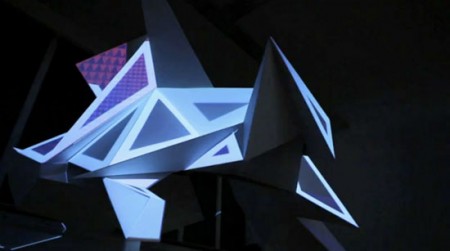
In January 2010 the Cologne based design agencies Grosse8 and Lichtfront presented their cross-media installation titled Augmented Sculpture. The core of the installation is a 2.5m tall wooden form that builds the screen for a 360° projection.
In constant transformation over a score by Jon Hopkins, the 2:32 minute performance is described by Svenja Kubler of Lichtfront as a “mirror of changing realities… a kind of real virtuality arises to confront virtual reality.” I’m not sure what that all means but I really like it.
www.lichtfront.com
www.grosse8.de


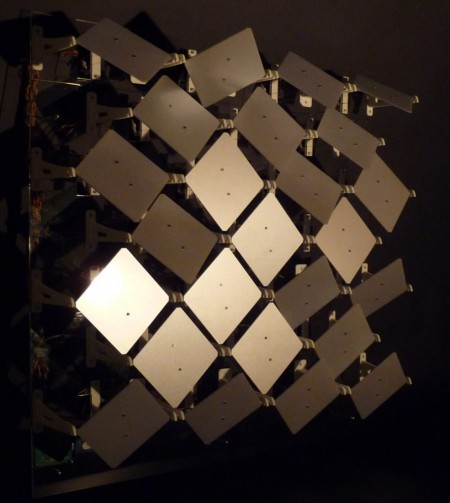
Here’s a great project that came out of the Adapative Architecture and Computation programme at the Bartlett School of Architecture. ‘Adaptive Fa[ca]de’ by Marilena Skavara explores the functional possibilities and performative characteristics of cellular automata (CA). In addition to the unique emergent behaviour of CA, a neural network enables a further computational layer to evolve CA behaviour to the context of its surrounding environment.
Building upon the early work of Conway’s ‘Game of life’ and Stephen Wolfram’s extensive research on the wider implementation of CA, ‘Adaptive Fa[ca]de’ becomes a living adapting skin, constantly training itself from the history of its own errors and achievements. For a more detailed description of the project, read Marilena’s article for Vague Terrain.

workflow mthod is mentioned in earlier post here: “Export Revit to EnergyPlus“, now these video tutorials are up on the openRevit YouTube channel:
Introduction
Room Bounding Objects and Material Construction
Zones, Model Review and GBXML Export
Ecotect Import, Model Review and Prep for IDF Export
Exporting IDF for EnergyPlus
Importing IDF into OpenStudio/Sketchup for Review
Construction Verification and Review in IDF Editor

Zebra Imaging 3D brings the future of 3D visualization, thanks to this thin holographic sheets.
Zebra Imaging makes digitally-mastered, actively-animated, true-color, full-parallax holographic images. These holographic images are available in full color, or in monochrome (green). Zebra’s holographic images can be scaled to any size, large or small. By tiling together multiple tiles, it is possible to create large city maps, full sized cars, humans, and machinery. The minimum you have to do is supply the digital data set–Zebra can do the rest.
More info here. Via Arch Daily.


Stunning video from “Discovery Channel’s series ‘Time Warp’ where MIT scientist and teacher Jeff Lieberman and digital-imaging expert Matt Kearney use the latest in high-speed photography to turn never-before-seen wonders into an experience of beauty and learning.”
It shows an experiment in which a water drop is filmed at 2000 frames per second, revealing something you probably never knew about the behavior of water.


Does this mean Google is set to become your power company? Not yet — instead, Google wants more control over the high energy costs of its many data centers, and also aims to become carbon neutral. A Google spokesperson told CNET: “Right now, we can’t buy affordable, utility-scale, renewable energy in our markets. We want to buy the highest quality, most affordable renewable energy wherever we can and use the green credits.”
There’s the possibility, however, that Google might become an energy provider. The same spokesperson said to CNET in January: “We don’t have any concrete plans. We want the ability to buy and sell electricity in case it becomes part of our portfolio.”
Via Mashable


Developed by Graphisoft, EcoDesigner is a plugin that allows the energy efficiency performance of a building model to be analyzed within the ArchiCAD environment. It is a relatively new plugin, launched at the AIA 2009 Convention alongside version 12 of ArchiCAD. At the core of EcoDesigner is the VIPCorecalculation engine, developed by Swedish company Strusoft. This is the same engine that is used by Strusoft’s standalone analysis program VIP-Energy, and is certified in accordance with recognized analysis standards, such as the ANSI/ASHRAE BESTEST Standard 140-2001.


