Showing posts with label interactive. Show all posts

Wednesday, 23 September 2009

Photosynth Point Export - Photosynth as a 3D Scanner?

Take a look at the movie below and make sure you watch it all the way through - note the export of the model from photosynth into a stand alone 3D package:


This opens up the possibility of using photosynth as a free 3D scanner, and one that would work on objects up to the building level scale. It seems to be early days but there is a lot of discussion going on around the tutorial here.

Via Digital Urban

Wednesday, 29 July 2009

3D Architectural Renderings


Great article on The purpose of architectural renderings and what's involved in the process:


While architectural renderings have been around for many centuries, computer-generated 3d architectural renderings is a relatively new field still in its infancy. If you do an Internet search for 'architectural renderings', you could easily pull up a hundred thousand results on the topic. The sheer number of results can be overwhelming. In this article, I will try to answer some of the most common questions regarding this field as well help people's understanding of this process and art form.

ContentsRead the full article HERE

Sketch Worlds: 3D Max and SketchUp Virtual Worlds for Architectural Visualization

SketchWorlds, based on RealXtend, is unique - a virtual world with architectural and property based visualisation at the heart of the system.

Of note is the ability to import direct from 3DMax and SketchUp allowing for quick and easy modelling within a virtual environment, something that is almost impossible with any degree of detail in other systems such as Second Life.

The movie below details the in-world editor, note the dynamic lighting:


As regular readers will know we have a bit of thing with HDR, SketchWorlds allows real time HDR rendering:


Take a look at http://sketchworlds.com/ for full details, from a first look it seems promising.

Via Digital Urban

Monday, 27 July 2009

LET ME LIVE: architecture final project by Nir levie and Tomer dikerman


Let Me Live is a Criticism project. The main criticism issue of the project is the duplication of dwelling buildings, and the "boring" spaces between them.
The project suggests a dwelling space that allows freedom, diversity, and personal compatibility for the user, while regarding limitations like building technology, performance and budget. The goal is to create personal relation between the resident and the dwelling spaces – and to improve the quality of the place.
In order to achieve that, a system which allows the development of personal dwelling units was developed. The system works in "mass customization" principles. The dwelling space is ordered by the decisions of the residents using a computer system.
In addition, a new building technology was developed, which allows the ability to create such space, economically. The building technology was developed in order to bridge between the theory and the practicality in architecture.

Project by Nir Levie and Tomer dikerman of
Tel Aviv University


Kiefer Technic Showroom: Architecture


In earlier times, façades were characterised by window arrangements and axes. They often featured surface relief with architectural elements from the relevant period or style. The structure of the façade also determined the ground plan; the greater the number of window axes in a room, the more important the function of the user.

Not long ago office buildings had a clear structure and the number of axes was predetermined - e.g. how many for a director or high-ranking counsellor and how many for a mere civil servant.
With the introduction of window strips, these hierarchies were abandoned. Today it is possible that the complete exterior façade is transparent, and this very transparency indicates a modern character. At the same time, individual requirements escalate and need to be reconciled with the desire for comfort.


For this reason dynamic façades has been developed which can be adapted individually to changing conditions and needs. Of course they can also be controlled by optimising programs if users are not present in the rooms behind. Thus it is possible to realise these new transparent façades and yet still maintain a cosy atmosphere in the rooms.

These façades change continuously; each day, each hour shows a new “face” - the façade is turning into a dynamic sculpture.

Below is a video demonstrating the facade transformations:


Kiefer Technic Showroom,Bad Gleichenberg,Austria by Giselbrecht + Partners

Via e-architect


Sunday, 26 July 2009

3D projection on German building created by UrbanScreen

This is probably the most elaborate 3D projection on architecture that I have ever seen. You don’t have to believe me, watch the video called“How it would be, if a house was dreaming” and say your opinion. The conception of this project consistently derives from its underlying architecture – the theoretic conception and visual pattern of the Hamburg Kunsthalle. The Basic idea of narration was to dissolve and break through the strict architecture of O. M. Ungers “Galerie der Gegenwart”. Resultant permeabilty of the solid facade uncovers different interpretations of conception, geometry and aesthetics expressed through graphics and movement. A situation of reflexivity evolves – describing the constitution and spacious perception of this location by means of the building itself. This was produced by Urbanscreen – Art Direction : Danier Rossa


Via freshome


Saturday, 25 July 2009

Pachube: Realtime Sensor Data Linked to SketchUp

Pachube is a web service available at http://www.pachube.com that enables you to connect, tag and share real time sensor data from objects, devices, buildings and environments around the world.

The key aim is to facilitate interaction between remote environments, both physical and virtual. If you have not heard of Pachube before it is well worth taking a look at their site and the exploring the concept which is a little bit like YouTube, except that, rather than sharing videos, Pachube enables people to monitor and share real time environmental data from sensors that are connected to the internet.

The linkages can now be visualised via SketchUp, the incoming data can be used to generate or modulate a 3D model of a building or environment, and enables sophisticated design-decisions that are based on actual (and not simulated) sensor and environment data. Possible uses include designing interactive façades, undertaking post-occupancy evaluation (which is where you evaluate how well the design performs) and sensor-based form generation.

Video below shows a demonstration of the plugin for sketchup. It shows real-time water, gas and energy usage from a building management system being graphed on top of a model of the building. Although in this demo the data is merely driving simple scalar transformations to visualize energy usage, the real potential of the plug-in is to serve Pachube data to real-world design tools to directly inform design decisions in a much more sophisticated way.

Download the plug-in and see the tutorial here: http://community.pachube.com/sketchup


Via Digital Urban


Sunday, 19 July 2009

ResoNet

resonet

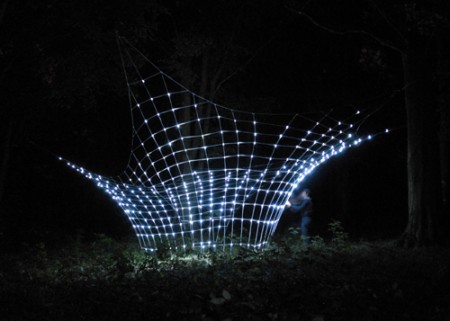
Designed by Mark Francis Tynan & William Hailiang Chen, ResoNet visualises the resonant frequencies inherent in the natural environment, via the interaction of the public and surrounding elements detected by a LED net. By using Low-Fi techniques ResoNet creates a cascade of light triggered by the vibrations detected across the structure.

ResoNet’s tensile web structure is stretched across a space, like a spider web. A series of vibration sensors & LED circuit components are fixed at key intersections on the tensile network, to detect minute vibrations as a result of human and natural activity.

Microsoft Word - Chen_Tynan_Proposal_Fred07.doc

Be it a brush of a hand, or a passing breeze, the energy is converted into light that resonates across the structure, immersing the public in a cascading visual of flashing LED’s

Via Interactive Architecture


Tuesday, 14 July 2009

HDR Meets After Effects

High Dynamic Range (HDR) photography brings out the full vibrancy of urban images. Brian Przypek has combined HDR with After Effects with notable results:

Popout

HDR Meets After Effects from Brian Przypek on Vimeo.


Brian is a Cinematographer, Photographer, HDR Enthusiast, check out red-shooter.com for more of his work.

Via Digital Urban

Thursday, 25 June 2009

World Builder: the Next Generation of SketchUp

The short film below could be "the SketchUp of the future."

The man in the film wants to build a virtual world for the woman he loves, and the way he creates it is very similar to how you'd do it in SketchUp. He starts with simple boxes, adds details like doors and windows, applies colors and textures, brings in some shadows, etc. Flowers and trees are a little more challenging at the moment in SketchUp, but maybe future versions WILL be this easy. Enjoy!


Via 3dvinci

Thursday, 18 June 2009

See the steps to model for Google Earth

If you've wondered what the process really looks like for getting a 3D model into Google Earth, you should check out this new video (also included below). You'll see a building created from scratch in SketchUp, pushed up for review, and placed in Google Earth for all to see. It's soup to nuts. The building is very simple and the reference photos are great for modeling (if I do say so myself).

This video provides step-by-step directions describing how to use photographs, Google SketchUp, Google Earth, and the Google 3D Warehouse to create and upload a model for consideration in Google Earth's 3D Building layer. Check it out when you have a chance.


Saturday, 13 June 2009

EVOGRID Visualisation


Rammy Elsaadany, a Masters of Architecture student at the Bartlett school of architecture, has just completed a collaborative film with Bruce Damer about the proposed EVOGRID project.

The film connects together a simplified version of the scientific narrative and also a conceptual development of what could possibly happen once the EVOGRID project is established. Rammy used a variety of techniques to achieve this film, including 3d modeling, compositing, and green screen. The software used includes 3D Max, After Effects, Premiere and Sound Booth.


See http://www.evogrid.org/index.php/Main_Page for more info - we really like this, its up there with some of the best work we have featured here on digital urban.

Take a look at Rammys YouTube channel for more work, he is currently working as a freelance so if any of you out there need one of the best new urban animators do get in touch with him.

Via Digital Urban


Thursday, 4 June 2009

Revit to Microsoft Project Connector Released

bimjet

A new release of the BIMjet Connect software was released this week. The Connector provides a bi-directional link between Microsoft Project and Autodesk Revit platforms. Enabling Architects and Contractors  to schedule complex BIM models for 4D visualization and construction scheduling.

Via Blgsim


Wednesday, 3 June 2009

XBox 360: Project Natal - Potential for Architectural and GeoVisualisation


Microsoft has announced the new Natal motion controller fro the XBox 360 at this years E3 conference. Natal is a small, device that sits underneath the screen and senors the users movement, completely eliminating the need for a controller.

This offers huge potential in the world of Urban visualisation, both in the professional realm and for communicating geography and architecture to a wider audience.

Game engines and gaming devices offer a lot of potential for visualisation and simulation and with Natal that has just got more interesting.

Via Digital Urban


Tuesday, 19 May 2009

Theo Jansen: The art of creating creatures

Artist Theo Jansen demonstrates the amazingly lifelike kinetic sculptures he builds from plastic tubes and lemonade bottles. His creatures are designed to move -- and even survive -- on their own.


Monday, 18 May 2009

Infinity Citizen

After succeeded Tenspace, young stag this splendid spot carried out by Japanese studio WOW for the Citizen mark At the time off the living room room Baselworld 2009 in Switzerland. The topic off film is centered one the possibilities infinity: mixture off images combined with has collecting off the town off Tokyo has.


infinity2

Via fubiz


Tuesday, 28 April 2009

Architectural Animation: Subprime

Popout
subprime from beeple on Vimeo.


The above movie entitled 'subprime' was created by beeple of beeple.com of particular note is the animation which amazingly was all done by hand in Cinema 4D.

Via Digital Urban

Friday, 24 April 2009

fLUX, Binary Waves


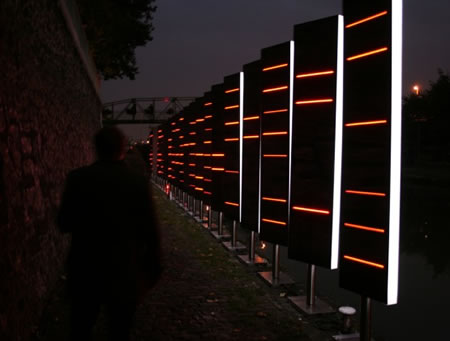
A great project by LAb[au], “fLUX binary waves” is an urban and cybernetic installation based on the measuring of infrastructural ( passengers, cars…) and communicational ( electromagnetic fields produced by mobile phones, radio…) flows and their transposition into luminous, sonic and kinetic rules.

The relation between the installation and the urban activity appears in real time and sets each person as an element of the installation, creating a centre of the public realm. The installation fLUX, binary waves is constituted by a network of 32 rotating and luminous panels of 3 meter-high and 60 centimetres wide, placed every 3 meters to form a kinetic wall.

The panels rotate around their vertical axis, and have a black reflective surface on one side, the other being plain mat white. The rotation of these panels is controlled by microprocessors, allowing to determine precisely the rotation speed and angle, while their networking allows to synchronize the movement of the 32 panels.

Below is a video showing a demonstration of the panels.


Via Interactive Architecture

Monday, 6 August 2007

Google Maps Image Cutter

Image Cutter is an application developed by CASA which takes any image and cuts it into tiles which then can be viewed interactively via a Google Map. Using this tool, the viewer is able to zoom and pan using the standard Google Map interface. This is a very useful tool to publish images on the web.

Below is an example using the Google Maps Image Cutter tool.


You can download Image Cutter for free which users java application to run the software and creates a html file and a directory folder of the tiled images which then can be uploaded to your server. For further info visit Digital Urban blog post.